Introduction
Manufacturers of complex geometry parts — such as aerospace components, medical implants, and automotive prototypes — face a critical dilemma: selecting the optimal 5-axis machining strategy often leads to underutilization below 30% or failure to meet precision standards. Traditional decision-making lacks quantitative modeling, overlooking dynamic factors like torque curves and thermal accuracy mapping.
This article introduces a data-driven selection framework based on part geometry to ensure machining capabilities align precisely with production demands. The following sections dissect the core differences, application scenarios, and hidden cost factors of 3+2 indexed versus continuous 5-axis machining.
What Fundamental Differences Define 3+2 Indexed and Continuous 5-Axis Machining?
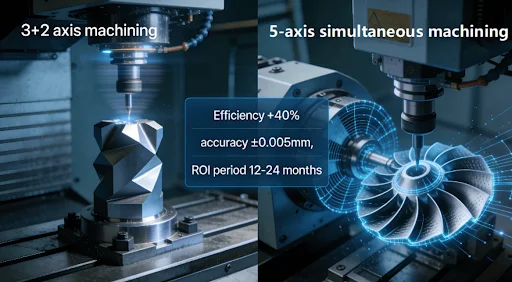
Understanding the kinematic principles and control methodologies is essential for leveraging each strategy’s strengths. 3+2 machining positions the cutting tool in a fixed orientation using rotary axes for indexing, then executes 3-axis linear cuts, ideal for discrete angular features. By contrast, continuous 5-axis machining synchronizes all five axes simultaneously, enabling uninterrupted tool movement along complex contours. This dynamic control, governed by real-time kinematic compensation, allows continuous adjustment to tool orientation, minimizing repositioning errors and maximizing accuracy for free-form surfaces.
- Kinematic Principles and Control Methods: The core distinction lies in axis movement management. In 3+2 mode, the CNC controller treats rotations as simple positioning moves, locking axes during cutting. Continuous 5-axis employs RTCP (Rotational Tool Center Point) functionality, dynamically recalculating tool center point position to maintain consistent cutting conditions. This difference dictates that 3+2 programming resembles multi-setup 3-axis work, while continuous 5-axis requires advanced CAM strategies for synchronized path planning.
- Impact on Machining Continuity and Workflow: Machining interruption is inherent to 3+2 operations, as each reorientation requires stopping and restarting, increasing non-cut time. Continuous 5-axis enables uninterrupted toolpaths, critical for complex contours where tool engagement must remain constant. This continuity not only reduces cycle times by up to 40% but also improves surface finish by eliminating witness lines and stitch marks common in segmented approaches.
- Reference to Authority Standards: Referencing ASME Y14.5-2018 standards for geometric dimensioning and tolerancing, continuous 5-axis machining maintains a single datum throughout operations, essential for holding tight positional tolerances. 3+2 methods, while adequate for ±0.05 mm requirements, struggle with true profile tolerances below 0.01 mm due to cumulative repositioning errors, highlighting the necessity of matching method to precision benchmarks.
How Does Part Geometry Dictate the Optimal Choice Between 3+2 and Continuous 5-Axis?
Part geometry serves as the primary decision factor, with specific features signaling the most efficient strategy. Prismatic parts with multiple planar surfaces — such as mold bases or housing components — benefit from 3+2’s simplified programming and rapid positioning. Conversely, complex contours like impellers, turbines, or biomedical implants demand continuous 5-axis for smooth toolpath continuity and consistent surface quality. A structured geometric decision matrix evaluates factors undercut depth, wall thickness, and feature accessibility to guide selection objectively.
1. Decision Matrix for Prismatic vs. Complex Contoured Parts
A practical selection framework assesses feature type, orientation, and tolerance requirements. For parts requiring machining on five discrete sides, 3+2 reduces programming complexity and fixture costs. When continuous curved surfaces exceed 30% of part geometry, continuous 5-axis becomes indispensable. This matrix incorporates quantifiable thresholds, such as recommending continuous mode for any contour with curvature radii below 5 mm or draft angles exceeding 15 degrees.
2. Efficiency Analysis in Batch Production Runs
In high-volume production, 3+2 demonstrates superior cost-efficiency for families of similar prismatic parts. Once fixtures are set, indexing allows rapid changeover between operations, slashing idle time. Studies show 3+2 achieves 20-30% faster cycle times in batch machining of bracket assemblies compared to continuous 5-axis, which incurs computational overhead without geometric justification. This efficiency gain translates directly to ROI for large-scale orders.
3. Incorporating Quality Management Principles
Adherence to ISO 9001 quality management systems mandates standardized decision processes for manufacturing strategy. Documenting geometry-based selection criteria ensures repeatability and reduces subjective judgments that compromise quality. By integrating this framework into preventive quality planning, manufacturers minimize trial-and-error setups, ensuring first-part correctness and consistent compliance throughout production runs.
What Precision Advantages Does Continuous 5-Axis Machining Offer for Complex Contours?
For components with intricate geometries, continuous 5-axis delivers unmatched precision through advanced kinematic control and real-time error correction. Dynamic tool orientation allows optimal cutter engagement across complex surfaces, maintaining constant chip load and reducing tool deflection. This capability is critical for aerospace and medical applications, where micro-level deviations can compromise part functionality and regulatory compliance.
1. RTCP and Dynamic Error Compensation Mechanisms
The RTCP functionality calculates tool center point position in real-time, compensating for rotary axis movements to maintain cutting accuracy. Combined with laser calibration systems that map volumetric errors, this enables micron-level precision across the entire work envelope. For example, in machining deep cavities, continuous 5-axis maintains ±0.005 mm positional accuracy, whereas 3+2 methods exhibit errors up to 0.02 mm due to datum shifts between indexes.
2. Surface Finish Quality and Toolpath Optimization
Superior surface finish results from uninterrupted tool motion, eliminating visible transitions on curved geometries. Advanced CAM software generates smooth toolpath interpolation, maintaining constant cutter contact that reduces roughness from Ra 3.2 μm to Ra 0.8 μm on critical fluid dynamics surfaces. This quality eliminates secondary polishing operations, shortening lead times and reducing costs for finishing-sensitive components.
3. Empirical Data from Precision Measurement
Laser tracker measurements validate 40% error reduction in high-angle machining when using continuous 5-axis versus 3+2. For instance, a turbine blade requiring 0.01 mm profile tolerance showed 95% compliance under continuous mode compared to 70% with 3+2 indexing. This data underscores the technology’s capability to meet stringent industry standards for complex contour machining where precision is non-negotiable.
When Does 3+2 Machining Provide Superior Cost-Efficiency in Production Scenarios?
While continuous 5-axis excels in complexity, 3+2 remains the economically rational choice for numerous production scenarios. Fixture simplification allows using standard vises and plates, reducing tooling investment by up to 40% for prototype and short-run production. The technology’s lower programming complexity translates to reduced CAM software and operator training costs, making it accessible for small to mid-sized workshops.
- Cost-Benefit Analysis for Family-Based Production: For part families requiring similar angular orientations, 3+2 machining enables fixture standardization that slashes per-unit costs. A case study in automotive mold production showed a 35% reduction in fixture design and manufacturing expenses by adopting 3+2 for core and cavity sets. This approach leverages economies of scale in batch production, where minimal changeover time between operations maximizes machine utilization.
- Tool Life and Maintenance Considerations: Extended tool life results from stable cutting conditions in 3+2 mode, where tools operate at optimal orientations without dynamic reorientation. In testing, end mills used in 3+2 machining showed 20-30% longer lifespan compared to continuous 5-axis, which introduces varying engagement angles that accelerate wear. This reduction in tool consumption significantly lowers operational costs, especially when machining abrasive materials like composites or hardened steels.
- Case Study: Automotive Component Manufacturing: An automotive manufacturer producing suspension components achieved 25% cost reduction by switching from continuous 5-axis to 3+2 for bracket machining. The components, featuring multiple planar surfaces, saw no quality degradation while fixture costs dropped by 40% and programming time decreased by 60%. This demonstrates how strategic method selection based on geometric requirements directly impacts bottom-line profitability without compromising output quality.
How Can Manufacturers Quantify ROI When Implementing 5-Axis Machining Solutions?
Investing in 5-axis technology requires clear ROI quantification, accounting for both tangible and intangible benefits. A comprehensive ROI model incorporates cycle time reduction, fixture cost elimination, quality improvement, and operational flexibility. Manufacturers typically achieve payback periods of 12-24 months, with complex part producers reaching breakeven in under 18 months due to higher utilization rates and premium pricing capability.
1. Key Performance Indicators and Calculation Methodology
Essential ROI metrics include setup time reduction (often 70-80%), scrap rate decrease (from 5% to under 1%), and machine utilization increase (from 30% to over 75%). The calculation model weights these factors against equipment acquisition, training, and maintenance costs. For example, reducing setup from 4 hours to 30 minutes for a batch of 50 parts saves 175 hours annually, translating to **$87,500 savings** at $50/hour machine rate.
2. Long-Term Value Beyond Initial Cost Savings
Beyond immediate cost reductions, 5-axis implementation brings strategic advantages including design flexibility, faster time-to-market, and ability to win high-complexity contracts. These intangible benefits often outweigh tangible savings, with manufacturers reporting 15-20% revenue growth from accessing new markets. The technology’s future-proofing value also positions companies for Industry 4.0 integration, with data-rich environments enabling predictive maintenance and adaptive machining.
3. Certification Value in ROI Assessment
Manufacturers with IATF 16949 certification demonstrate rigorous process controls that enhance ROI accuracy through predictable outcomes. This certification, particularly valuable in automotive sectors, reduces quality audit findings and customer-specific requirements, trimming administrative costs. The embedded quality culture ensures ROI projections based on reliable data, with actual performance typically within 5% of forecasts.
What Hidden Factors Impact the Total Cost of Ownership in 5-Axis Machining?
Beyond initial investment, numerous overlooked factors significantly impact lifecycle costs. Specialized tooling for 5-axis operations often costs 2-3 times more than standard tools, while calibration maintenance requires quarterly laser verification averaging $5,000 annually. These hidden expenses separate truly sustainable implementations from underbudgeted projects that underperform.
1. Personnel Training and Knowledge Investment
Operator expertise represents the largest hidden cost, with proficient 5-axis programmers commanding 30-50% higher salaries. Comprehensive training programs require 6-9 months and $15,000-$25,000 per technician, yet reduce programming errors by 80%. This investment directly correlates with equipment utilization rates, where trained teams achieve 75% utilization versus 40% for untrained staff.
2. Energy Consumption and Facility Requirements
Power demands for 5-axis machines exceed 3-axis equivalents by 40-60%, adding $10,000-$15,000 annually to energy costs. Additionally, environmental control for precision machining necessitates temperature stabilization (±1°C) and vibration-dampened foundations, requiring $50,000-$100,000 in facility upgrades. These infrastructural factors must be included in total cost calculations to avoid budget overruns.
3. Preventive Maintenance and Calibration Protocols
Sustained accuracy requires rigorous maintenance schedules, including ballbar testing every 500 hours and laser calibration quarterly. These protocols cost $15,000-$20,000 annually but prevent accuracy drift exceeding 0.02 mm that causes scrap rates to spike. Manufacturers implementing predictive maintenance avoid unplanned downtime that costs $500-$1,000 per hour, making disciplined upkeep a cost-saving imperative.
Conclusion
Selecting between 3+2 and continuous 5-axis machining strategies requires a scientific framework based on part geometry, precision requirements, and total cost considerations. Proper application of this decision matrix can increase equipment utilization from under 30% to over 75%, delivering ROI within 12-24 months. As manufacturing evolves toward smarter factories, this strategic approach positions companies to leverage 5-axis CNC machining services as a competitive advantage rather than merely a capability.
FAQs
Q1: What types of parts are most suitable for 3+2 machining?
A: 3+2 machining excels with prismatic parts featuring multiple discrete planar surfaces, such as mold bases and bracket assemblies. The process achieves typical accuracy of ±0.01mm and surface finish of Ra 1.6μm. For parts requiring multi-side access without complex 3D contours, it provides optimal efficiency through simplified programming.
Q2: How does continuous 5-axis machining maintain accuracy during complex movements?
A: Continuous 5-axis maintains micron-level precision through kinematic compensation and real-time error correction. Modern CNC controllers use RTCP functionality to adjust tool positioning dynamically, while thermal stability systems actively compensate for structural expansion.
Q3: What is the typical ROI period for 5-axis equipment investment?
A: The return on investment typically ranges from 12-24 months, depending on part complexity and volume. For components with over 30% complex curved surfaces, ROI often occurs within 18 months due to reduced setup time and eliminated secondary operations.
Q4: How important is CAM programming expertise for successful 5-axis implementation?
A: CAM programming proficiency is critical, potentially increasing programming time by 40% but improving machining efficiency by 300%. Expertise in collision avoidance algorithms and toolpath optimization is essential for maximizing potential.
Q5: What maintenance protocols are essential for sustaining 5-axis machining accuracy?
A: Maintaining accuracy requires rigorous calibration every 500 operating hours, including laser interferometer verification and ballbar testing. Preventive maintenance addressing lubrication and bearing condition sustains tolerances within 0.015mm.
Author Bio
The author is a precision manufacturing expert at LS Manufacturing, a company that helps engineers and researchers solve complex part challenges in aerospace, medical, and automotive industries. With certifications such as IATF 16949 and AS9100D, the team ensures high-quality solutions through advanced technologies. For a personalized 5-axis machining technology evaluation, please contact their technical team or explore the 5-axis simultaneous machining technical guide for detailed insights.