Guest posting is the practice of creating an original article for another website or publication. Done well, it can introduce a brand to new readers, demonstrate useful expertise, generate referral visits, and build relationships with editors and industry peers.
A backlink can be a worthwhile outcome, but it should not be the reason the article exists. For brands that need support managing the process, vazoola.com outlines Vazoola’s guest-post service, which combines content creation, publisher outreach, and placement review.
Vazoola operates in broader link-building service areas, including blogger outreach and agency support, making it a relevant example of how guest posting can fit into a structured SEO and content marketing workflow.
Key Takeaways
⦁ Prioritize reader value and relevance over backlinks alone.
⦁ Choose publishers based on audience fit, content quality, trust, and activity.
⦁ Pitch original topics that fill genuine content gaps.
⦁ Create specific, useful articles that demonstrate real expertise.
⦁ Keep links natural, limited, relevant, and transparent.
⦁ Measure referral traffic, engagement, leads, and relationships, not just rankings.
⦁ Focus on fewer, stronger placements to build lasting authority and credibility.
Why A Reader First Plan Matters
A useful guest post should still help someone who never clicks a link. When an article answers a real question, offers practical context, or helps readers make a better decision, the host publication has a reason to publish it, and its audience has a reason to trust it.
That value can support several goals simultaneously, including visibility, thought leadership, qualified referral traffic, and future collaboration opportunities. Start by defining one primary campaign goal. A local home services company may want visibility in a regional publication that reaches homeowners in its service area.
A software company, on the other hand, may benefit more from a specialized industry site where readers understand a specific operational challenge. Clear goals make it easier to choose publishers, topics, and landing pages that actually fit.
Choose Topics That Belong On The Host Site
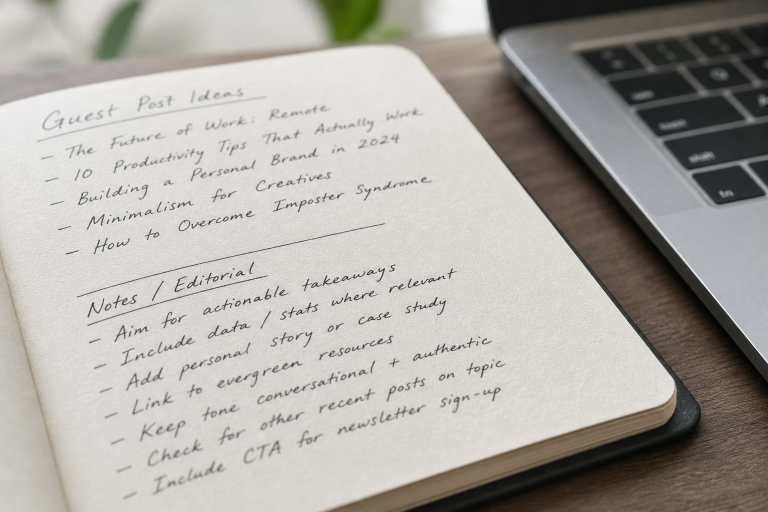
The strongest guest-post ideas sit at the intersection of your expertise and the host site’s audience needs. Before pitching, review recent articles, recurring categories, author styles, reader comments, community discussions, and questions that appear in the industry. Look for an important gap rather than proposing a topic that the publication has already covered repeatedly.
A Quick Topic Review
⦁ Read at least several recent articles to understand the publication’s tone and depth.
⦁ Identify questions readers still need answered.
⦁ Check that your proposed article contributes a distinct angle, example, or framework.
⦁ Remove product language from the working headline and introduction.
⦁ Confirm that the writer has genuine experience or research to support the advice.
For example, “How To Prepare A Small Business For A Website Redesign” gives readers a useful planning framework. A headline focused on a single company, service, or product usually feels promotional before the article even begins.
Evaluate Websites Beyond SEO Metrics
Authority scores, estimated traffic, and backlink data can help organize research, but they are not a complete quality review. A smaller, more relevant publication with active readers may be a better fit than a large general-interest site with no meaningful connection to the topic. Review each prospect for topical relevance, recent publishing activity, clear author information, original writing, visible editorial standards, real reader engagement, and a reasonable pattern of outbound links. Be wary of websites that publish unrelated articles across every imaginable industry or appear to exist mainly to place links. Search teams should also understand search spam rules before pursuing placements at scale.
Build A Focused Prospect Shortlist
A simple scorecard prevents weak prospects from taking too much time. Rate each website from one to five in the following areas:
⦁ Relevance: Would its readers care about the proposed article?
⦁ Content quality: Is the writing original, clear, and edited?
⦁ Activity: Has the publication posted useful material recently?
⦁ Trust: Are author profiles, contact details, and editorial information available?
⦁ Audience potential: Could the placement attract readers who may value your expertise?
A smaller list of strong matches is easier to personalize, track, and develop into long-term editorial relationships than a large list built only around metrics.
Write Pitches Editors Can Use
A good pitch is brief, specific, and designed around the publication’s readers. Use a personal greeting, mention a relevant recent article or an audience need, offer one clear topic, explain the reader benefit, include two or three closely related writing samples, and end by asking whether the idea fits the publication’s submission process. Avoid mass-produced messages, lengthy company biographies, several unrelated ideas, ranking guarantees, and demands for specific commercial anchor text. If a follow-up is necessary, make it polite and limited. Editors are more likely to respond when the message makes their decision easier.
Create Content That Earns Its Place
Published guest content should have a focused headline, a brief opening that identifies the problem, short, readable paragraphs, descriptive subheadings, and a conclusion that provides a next step for readers. Generic advice is easy to produce. Specific details, such as first-hand lessons, customer questions, interviews, original comparisons, public research, or useful examples, give an editor a better reason to accept the piece.
Use Links Naturally And Transparently
A link should add context, evidence, or a helpful next action for the reader. Use descriptive wording, point to the page most relevant to the claim, and avoid repeating identical anchor text across placements. Keep promotional links limited and follow the publisher’s requirements for disclosures and link attributes.
Guest articles become risky when they are produced primarily to manipulate rankings rather than inform readers. Google has specifically addressed large-scale link campaigns, making reader value and editorial relevance essential safeguards.
Measure Results Beyond Rankings
Rankings can change for many reasons, so evaluate each placement with a broader view. Track referral sessions, engaged visits, email signups, qualified leads, assisted conversions, branded search interest, publisher mentions, and new relationships with editors or experts. These signals show whether the article reached an audience that cared about the message.
Common Mistakes To Avoid
⦁ Choosing a website only because it has a high authority score.
⦁ Submitting the same article to multiple publications.
⦁ Pitching topics unrelated to the host audience.
⦁ Adding too many links or using repetitive anchor text.
⦁ Ignoring paid-placement disclosure requirements.
⦁ Failing to review the live article, author details, and final links.
⦁ Calling a campaign successful simply because a backlink exists.
A 30 Day Guest Posting Plan
⦁ Days 1 to 5: Define the audience, primary goal, and pages that may genuinely support readers.
⦁ Days 6 to 10: Research publications and score each prospect for relevance, quality, activity, trust, and audience fit.
⦁ Days 11 to 15: Develop tailored ideas, writing samples, and personalized pitches.
⦁ Days 16 to 22: Write, edit, fact-check, and format approved articles.
⦁ Days 23 to 26: Confirm links, disclosures, author bios, and publisher requirements.
⦁ Days 27 to 30: Review live placements, referral activity, and feedback that can improve the next round.
Conclusion
A durable guest-posting plan begins with relevance, trust, and useful writing. When every article makes sense for the host audience, helps readers without requiring a click, and supports a clear business goal the backlink becomes a natural part of valuable content rather than the campaign’s sole purpose.
Consistently choosing reputable publications, researching genuine content gaps, and contributing original insights can also strengthen relationships with editors and industry audiences.
Over time, this approach can improve brand recognition, generate qualified referral traffic, demonstrate expertise, and build a stronger online presence without relying on high-volume or low-quality placements.