Introduction
In the current landscape of digital art creation, designers frequently encounter significant hurdles during the prototyping phase. The prevailing pain point is the dual challenge of insufficient precision and low efficiency, often leading to costly prototype rework and project budget overruns. The core reason for these issues often lies in the limitations of traditional methods like 3D printing or handcrafting, which lack the necessary high-precision control due to suboptimal tool selection and process design.
This article proposes a solution: the integration of professional CNC milling services into the workflow. By leveraging precision machining and digital integration, this approach significantly enhances both the quality and efficiency of art prototype development. The following sections will provide a detailed analysis of how CNC milling is revolutionizing this field.
What is CNC milling Service, and How is it Applied in Art Prototype Making?
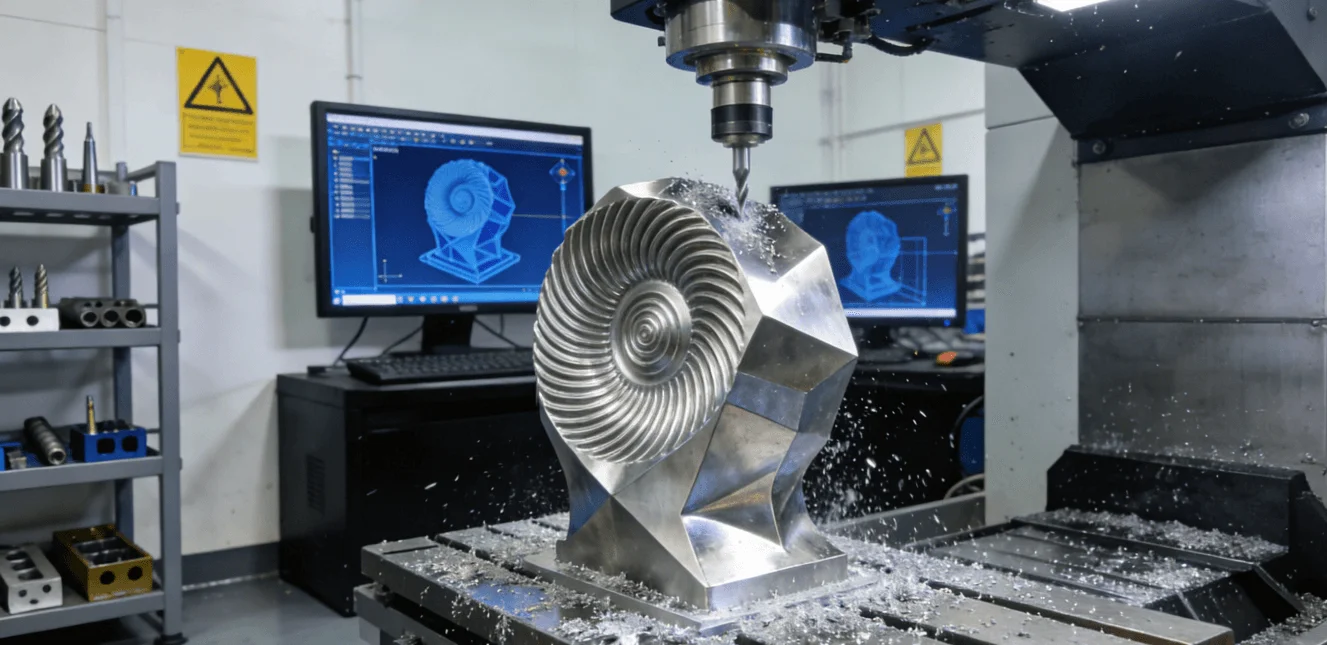
CNC milling services represent a cornerstone of modern digital manufacturing. It is a subtractive process where a computer-controlled machine precisely removes material from a solid block using rotating cutting tools to create a custom-designed part. In the context of Rapid Art Prototyping, this technology translates intricate digital 3D models directly into physical objects with exceptional accuracy.
The advantages for artists and designers are substantial. Firstly, CNC milling machining offers unparalleled precision, capable of achieving tolerances as tight as ±0.025mm, ensuring that even the most delicate details of a digital sculpture are faithfully reproduced. Secondly, it supports a vast array of materials, from easily machined plastics like ABS and polycarbonate to metals like aluminum and brass, providing unparalleled flexibility for aesthetic and functional requirements. Proper Face Mill Selection Guide is critical, as the choice of tooling directly impacts surface finish, detail sharpness, and overall machining time. Organizations like the International Society for Precision Engineering (ISPE) establish rigorous standards that highlight the importance of such controlled processes for achieving high-fidelity outcomes.
Why is Precision Crucial in Art Prototype Making?
Precision is not merely a desirable attribute in art prototype making; it is a fundamental requirement that dictates the success of a project. Insufficient precision can lead to a cascade of problems that compromise both the form and function of a prototype.
The High Cost of Precision Errors
When prototypes lack accuracy, the consequences are immediate and expensive. A common issue is assembly error, where separate components of a larger artwork simply do not fit together as intended. This necessitates time-consuming manual adjustments or a full re-fabrication of parts, leading to delays and increased costs. Furthermore, for functional art prototypes or those intended for reproduction, dimensional inaccuracy can render the entire piece unusable, wasting significant resources. The Journal of Digital Art and Technology has published research underscoring that as digital art becomes more complex and integrated with mechanical systems, the demand for precision in prototyping grows exponentially.
The Advantage of CNC Milling Precision
Precision CNC milling directly addresses these challenges by offering a level of accuracy that manual methods cannot match.
l Dimensional Fidelity
CNC machines execute instructions from CAD models with microscopic precision. This ensures that every curve, angle, and dimension of the digital design is replicated exactly in the physical prototype, eliminating assembly issues and guaranteeing the artist’s vision is perfectly realized.
l Surface Quality
The quality of the surface finish is a critical aspect of many art pieces. CNC milling precision allows for exceptionally smooth finishes directly from the machine, minimizing the need for post-processing. This is vital for prototypes that will be used to create molds or for final pieces where surface aesthetics are paramount. High-quality art prototyping solutions powered by CNC technology ensure that the first prototype is often very near the final desired quality.
How Does CNC Milling Optimize the Digital Manufacturing Process?
CNC milling machining serves as a powerful engine for optimizing the entire digital manufacturing workflow for art prototypes. Compared to traditional methods, it introduces significant gains in speed, reliability, and integration.
The process begins with a finalized 3D digital model. This model is directly converted into toolpaths for the CNC machine, creating a seamless digital thread from design to physical part. This integration eliminates the interpretation errors common in manual fabrication. The speed of precision CNC milling services is a key advantage, as complex parts can be produced in a matter of hours, drastically accelerating the iteration cycle.
Moreover, CNC milling offers exceptional repeatability; once a program is verified, producing multiple identical copies is straightforward and cost-effective. This is crucial for limited-edition art series or functional testing. Providers that adhere to stringent quality management systems, such as the ISO 9001 certification held by JS Precision, ensure that this optimized process consistently delivers reliable, high-quality parts.
Which Art Prototype Projects Are Best Suited for CNC Milling Services?
While versatile, CNC milling services are particularly well-suited for specific types of art prototype projects where their unique capabilities provide the greatest benefit.
Complex Sculptural and Functional Prototypes
Projects that demand high detail, structural integrity, or specific material properties are ideal candidates for CNC machining.
l Detailed Sculptures and Maquettes
For artists creating complex sculptures with intricate geometries, undercuts, and fine textures, precision CNC milling parts with multi-axis capabilities can achieve a level of detail impossible through most 3D printing or hand-sculpting methods. This allows artists to work confidently with hard materials like metal or dense hardwood early in the design process.
l Functional and Kinetic Art
Prototypes for art that moves or has a functional component—such as kinetic sculptures, custom lighting fixtures, or interactive installations—require precise tolerances to ensure proper operation. CNC milling provides the dimensional accuracy needed for gears, bearings, and other mechanical elements to function smoothly from the first prototype.
Material-Specific Applications
The extensive material library supported by CNC milling services opens up vast possibilities. Artists can prototype with the exact material intended for the final piece, whether it be a specific grade of aluminum for its weight and finish, a durable engineering plastic for outdoor use, or a luxurious brass or bronze for aesthetic appeal. This eliminates the guesswork associated with prototyping in one material and producing the final piece in another. Many successful case studies demonstrating these applications can be found by exploring professional CNC milling services providers.
How to Choose a Reliable CNC Milling Service Provider?
Selecting the right partner for CNC milling services is critical to the success of an art prototyping project. Several key factors should be considered to ensure quality and reliability.
First, evaluate the provider’s technical capabilities, including the range of materials they support, the types of CNC machines (e.g., 3-axis vs. 5-axis), and their achievable tolerances. Second, review their experience and portfolio, specifically looking for examples similar to your project in complexity and industry. Third, and most importantly, assess their quality assurance processes. Certifications are a strong indicator of a systematic approach to quality. A provider holding an AS9100D certification, for instance, demonstrates a commitment to exceeding standard quality management practices, which is a significant advantage for mission-critical prototypes. Finally, consider their communication and support; a provider that offers design for manufacturability (DFM) feedback can be an invaluable partner in optimizing your design for both cost and performance.
Choosing a provider with robust credentials, such as the AS9100D certification advantage , ensures a professional and reliable partnership.
Conclusion
In summary, integrating professional CNC milling services into the digital art prototyping workflow presents a formidable solution to the chronic issues of precision and efficiency. By harnessing the power of digital manufacturing, artists and designers can achieve higher fidelity to their original vision, reduce costly iterations, and accelerate time to completion. This approach effectively safeguards projects against budget overruns and delays.
To experience these benefits firsthand, designers are encouraged to immediately engage with a qualified service provider to obtain a custom solution and optimize their next prototype project.
Author Biography
The author is a specialist in the precision manufacturing sector with over a decade of experience, focusing on innovations in CNC technology and digital manufacturing processes.
FAQs
Q1: Are CNC milling services suitable for small art prototypes?
A1: Yes, CNC milling services can effectively handle small-batch projects. Through parameter optimization and efficient programming, they can be cost-effective while still meeting the stringent precision requirements of small-scale art prototypes.
Q2: How can surface smoothness be ensured for an art prototype?
A2: Selecting a high-precision CNC milling process is the first step. This can then be combined with post-processing techniques like polishing or bead blasting to achieve a mirror-like finish, significantly reducing the need for manual touch-ups.
Q3: What is the relationship between digital manufacturing and CNC milling?
A3: Digital manufacturing uses integrated CAD data to guide the entire production process. CNC milling acts as the physical execution arm of this data, creating a seamless and efficient workflow from digital design to tangible prototype.
Q4: Is the cost of CNC milling typically higher than 3D printing?
A4: The initial cost for CNC milling might be higher for a single unit. However, in the long term, and for projects requiring high durability or multiple copies, its ability to reduce rework and use superior materials often makes it more economically viable.
Q5: How can the quality of a CNC milling service be verified?
A5: Quality can be assessed by reviewing the provider’s certifications, such as ISO 9001, and by requesting sample parts for testing. This helps verify their ability to maintain specified tolerances and work with compatible materials.