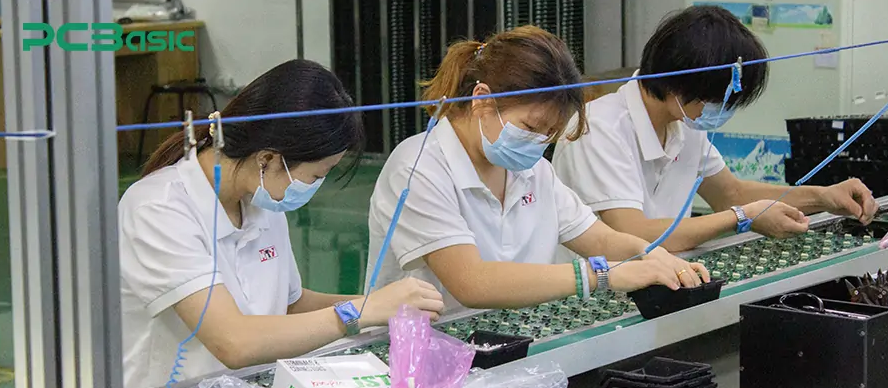
When choosing a PCB assembly manufacturer like PCBasic—a trusted partner for full turnkey assembly services—you’re likely focused on quick turnaround times and high yields during production. Whether you’re moving from design to PCB prototype or scaling up to full production, these initial metrics are undeniably important. However, assembly success on paper doesn’t always translate into long-term reliability in the field. Understanding the difference between the two can help engineers and procurement managers make smarter decisions that balance cost, time, and performance for their projects.
What Is Assembly Success?
Assembly success refers to the immediate outcomes of a PCB assembly process. Key indicators include:
- High first-pass yield (FPY) — A large percentage of boards pass inspection without rework.
- Accurate component placement and solder joints — Components are positioned and soldered according to design specifications.
- Minimal defects identified during inspection — Issues detected via automated optical inspection (AOI), X-ray, or electrical testing are within acceptable thresholds.
Assembly success is a snapshot of production performance. It’s an important benchmark that tells you how well your chosen partner, such as PCBasic, executed your design specs. However, it’s primarily short-term and process-centric. It doesn’t guarantee that the board will perform reliably under real-world conditions over the long run.
What Defines Reliability?
Unlike assembly success, reliability measures how a PCB performs over time, especially under stress. It’s judged by:
- Thermal endurance — Performance under repeated temperature cycles.
- Mechanical resilience — Resistance to vibration, shock, and handling stresses.
- Environmental stability — Longevity in conditions like humidity, dust, or corrosive environments.
- Operational lifespan — How long the PCB can consistently function without failure in real-world applications.
Reliability matters most when your PCB is deployed in critical systems—such as medical devices, industrial automation, or aerospace electronics—where failures can mean costly downtime or safety risks.
Why Assembly Success Alone Isn’t Enough
A PCB might come off the assembly line with excellent initial metrics yet fail prematurely if reliability wasn’t factored into the entire production lifecycle. For example:
- Material choices (e.g., substrate grade, finish type) can influence thermal cycling performance.
- Process controls — Tight solder paste deposition and controlled reflow profiles not only reduce defects, they help prevent cold joints that weaken over time.
- Testing depth — Basic functional tests check if a board powers up; extended tests (such as burn-in or accelerated life testing) assess durability.
PCBasic’s approach integrates both assembly success and reliability into its quality framework. With advanced manufacturing execution systems (MES), in-line inspection technologies, and robust design for manufacturability (DFM) support, PCBasic helps customers reduce defects and optimize long-term performance.
How PCBasic Supports Reliable Outcomes
PCBasic doesn’t stop at meeting specs; it seeks to ensure your PCBs are built to last. This includes:
- Engineering collaboration from pre-production — Reviewing design files early to address potential reliability risks.
- Material traceability and control — Using certified component sources and maintaining consistent inventory quality.
- Comprehensive testing protocols — Including electrical, environmental, and mechanical validations that go beyond basic assembly checks.
- Continuous improvement — Using SPC (statistical process control) and quality data to refine processes and raise reliability benchmarks.
Balancing Success and Reliability
For most products, the goal is to achieve both solid assembly success and proven reliability. This balance drives:
- Lower total cost of ownership — Fewer field returns, less rework, and reduced warranty costs.
- Stronger brand reputation — Delivering products that customers trust.
- Greater competitive advantage — Especially in markets where durability is a differentiator.
Conclusion
Understanding the distinction between assembly success and reliability is critical for delivering electronics that not only work but endure. While high yields and defect-free production are essential, they’re only part of the equation. Long-term performance, environmental resilience, and lifecycle stability define true reliability. By partnering with an experienced PCB assembly manufacturer like PCBasic, and leveraging thoughtful design, quality materials, and rigorous testing, companies can confidently bridge the gap between immediate success and lasting reliability.