In the fast-paced world of modern travel, our digital devices are far more than just sources of entertainment. They are our primary navigators, our digital wallets, our communication hubs, and our cameras for capturing once-in-a-lifetime memories. However, these tools are only as useful as the battery life they possess.2 This is why a high-quality power bank has transitioned from being an optional accessory to an absolute survival necessity for any serious journey. Whether you are trekking through the remote highlands of Scotland or navigating the bustling terminals of JFK, having a reliable source of backup energy is the ultimate form of travel insurance.
While portable chargers come in a dizzying array of shapes, sizes, and capacities, the 20000mAh power bank has emerged as the definitive gold standard for long-distance trips. It represents the perfect equilibrium between raw energy capacity and physical portability. For many travelers, this specific size is the “sweet spot” that provides enough juice to last for a long weekend without the excessive weight of industrial-grade battery packs. It is small enough to fit into a backpack’s side pocket but powerful enough to ensure that you are never left stranded with a dead phone in an unfamiliar city.
The Science of “Just Right” Capacity
When we talk about 20,000mAh, we are talking about a significant reservoir of potential energy. To put this into perspective, most modern flagship smartphones, such as the iPhone 15 Pro or the Samsung Galaxy S24, feature internal batteries ranging from 3,300mAh to 5,000mAh. A charger with a 20,000mAh capacity provides roughly four to five full recharges for these devices.
On a long-haul flight or a cross-country road trip, this capacity is transformative. It means you can watch movies, play games, and use GPS at full brightness without constantly glancing at your battery percentage with anxiety. If you are traveling as a couple or a small group, this single unit can often support two or three people’s phones for an entire day of sightseeing. It eliminates the “outlet hunt” at crowded airports or cafes, allowing you to stay mobile and independent.
Navigating Airport Security and FAA Regulations

One of the most critical reasons to choose this specific capacity involves the legalities of air travel. The Federal Aviation Administration (FAA) and the Transportation Security Administration (TSA) in the United States, along with international bodies like EASA, have very strict regulations regarding lithium-ion batteries. These rules are designed for safety, as large batteries can pose a fire risk if they malfunction.
Generally, passengers are permitted to carry batteries that do not exceed 100 watt-hours (Wh) in their carry-on luggage. Calculating the watt-hours of a battery is a simple formula:
(mAh x Voltage) / 1000 = Wh
. Most 20,000mAh units operate at a nominal voltage of 3.7V, which results in approximately 74Wh (20,000 x 3.7 / 1000 = 74). This places the device comfortably under the 100Wh limit. By choosing this size, you ensure that you are carrying the maximum amount of “legal” power allowed without needing special airline permission or risking confiscation at a security checkpoint.
Powering an Entire Tech Ecosystem
Modern travel rarely involves just a single device. A typical traveler’s bag might contain a smartphone, a pair of noise-canceling headphones, a tablet or e-reader, and perhaps a smartwatch or a GoPro. Each of these devices competes for power, and a smaller 5,000mAh or 10,000mAh battery simply cannot keep up with the demand of a multi-device setup.
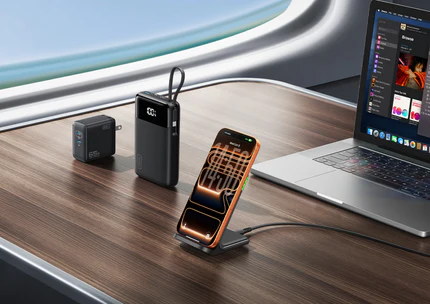
A 20,000mAh unit usually features multiple output ports, often including the latest USB-C Power Delivery (PD) technology and standard USB-A ports. This allows for “multi-device charging,” where you can top off your wireless earbuds while your iPad remains powered for a 12-hour flight. For digital nomads, some high-wattage 20,000mAh models can even provide a “life-support” charge to a laptop like a MacBook Air. Having one central hub that can replenish every piece of tech in your bag simplifies your packing list and reduces the number of international wall adapters you need to carry.
The Importance of Fast Charging on the Move
In the past, high-capacity batteries were notoriously slow to charge. It could take twelve hours or more to fill up a large brick, which wasn’t practical when you’re moving between hotels or have a short layover. However, modern 20,000mAh chargers have evolved significantly. Most now feature bidirectional fast charging, allowing them to both deliver and receive power much more efficiently.
This technology works two ways: first, it can fast-charge your phone from 0% to around 50% in roughly 30 minutes. Second, the battery itself can be recharged at high speeds. Devices like the INIU P62-E1 Power Bank (20000mAh, 65W) are designed with this modern charging architecture, supporting high-wattage input and output so the power bank itself refills much faster than older models.
Reliability in Unpredictable Environments
Travel is inherently unpredictable. Flights get delayed, buses break down, and hotel reservations occasionally go sideways. In these stressful situations, your phone is your lifeline. It is how you rebook a flight, call a rideshare, or find an alternative hotel. If your battery dies during a crisis, a stressful situation can quickly become a dangerous one.
A high-capacity battery acts as a safety net. It ensures that even if you are stuck in an airport overnight or lost in a rural area where the power grid is unreliable, you maintain a connection to the world. It provides the freedom to use your phone’s most power-draining features—like high-accuracy GPS and 4K video recording—without having to “ration” your battery for the end of the day.
Durability and Long-Term Investment
While cheaper, lower-capacity batteries might seem attractive for their price, they often lack the sophisticated circuitry found in premium 20,000mAh models. These larger units are typically built with better safety features, such as overcharge protection, short-circuit prevention, and temperature control.
Furthermore, because you aren’t fully depleting and recharging a large battery as often as a small one, the internal cells tend to last longer over many years of travel. Investing in a robust, high-capacity charger is a long-term commitment to your travel gear that will serve you through dozens of trips, from weekend getaways to month-long international expeditions.
Conclusion
When you weigh the benefits of portability against the necessity of power, the 20,000mAh capacity stands alone as the most logical choice for the modern traveler. It respects the strict boundaries of airline safety while providing enough energy to keep an entire suite of electronics running for days on end. It eliminates the “low battery” anxiety that can ruin a perfectly good vacation and provides a reliable anchor in the unpredictable world of global travel. If you are looking for the one piece of gear that will truly change how you experience long trips, this is it.