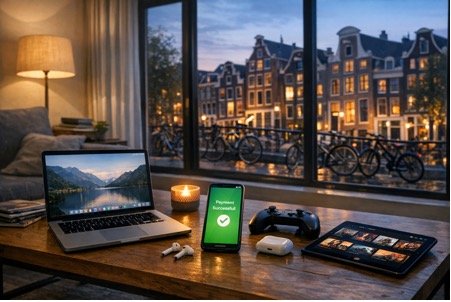
In the Netherlands, digital payment has become part of daily routine. That habit spills into online entertainment, where people subscribe, tip, buy, and browse with little pause. De Nederlandsche Bank says cash made up about one in five shop payments in 2024, while phones handled almost one in five in store payments.
Yet local habits still matter. In the first half of 2025, iDeal processed 70% of online purchases, down from 73% a year earlier, while Klarna moved from 3% to 4%. The pattern shows a market that trusts digital payment, but still pays close attention to speed, familiarity, and device fit.
How Dutch Habits Guide Choice
Payment choices shape how Dutch audiences subscribe, buy, and come back. Deloitte says 73% use video streaming subscriptions and 52% use music services. Entertainment often sits between local habits and global payment systems.
Paying Online Already Feels Natural
That movement works because paying online already feels normal to many Dutch consumers. Only 32% say they worry about digital payment privacy, which is the lowest share in the euro area. As a result, the question is often not whether people will pay online, but whether a platform offers the payment style they prefer.
That comfort does not erase the need for a familiar checkout, especially in sectors where security is paramount. For example, players looking to verify safe transaction methods often consult an online casino iDEAL guide to ensure their chosen platform maintains these high Dutch standards. When the method feels right and is backed by expert review, fewer users stop to think about the payment step.
Even so, the mix keeps changing. iDEAL handled 70% of online purchases in early 2025, but that was down from 73% a year before. Smartphones drove 40% of online purchases, which makes fast mobile checkout hard to ignore.
Entertainment Payments Follow Familiar Routes
That mix changes once Dutch users enter global entertainment platforms. De Nederlandsche Bank says online card payments reached 306 million in 2024, worth €24 billion, according to DNB statistics. Online debit card payments also tripled to 76 million between 2022 and 2024.
The same bank links that growth to streaming subscriptions, gaming purchases, digital wallets, and cross border sellers. It also points to wallets such as Apple Pay and Google Pay, which fit repeat payments well. This helps explain why local shopping may favor iDeal, while entertainment often leans on cards and wallets.
The pattern shows up in several common moments. Device choice matters because payment often happens in the middle of entertainment, not at the end of a careful shopping trip. Video and music services depend on payments that can repeat each month without extra steps. Quick tips and in app buys often happen on phones, which made 40% of online purchases in early 2025. Phone spending averaged €79, while laptop spending reached €122, so mobile checkout must feel light and fast.
Deloitte found that 73% of Dutch consumers use video streaming subscriptions and 52% use music services. In the past year, 25% of households signed up for a video service and 20% cancelled one. Cost is a clear pressure point, with 27% saying a service was too expensive and 19% saying they already had too many subscriptions. Payment friction can push that switching even faster.
Convenience Still Needs Clear Guardrails
Convenience can also create strain when payment feels too easy. The AFM says buy now, pay later transactions rose 17% in 2024 to about 53 million, worth €5.1 billion. It also recorded 6.9 million default notices, 1.8 million late fee charges, and about 0.6 million cases sent to debt collection.
Dutch users also manage digital life very actively. Deloitte says 21% removed a social media app in the past year, 19% added one, 51% turned off notifications, and 16% set screen time limits. People are pruning, returning, and reshuffling services instead of staying put. That behavior rewards platforms that make payment rules easy to read. Clear signals matter because users judge both convenience and control.
Recognizable payment methods and security cues reduce hesitation. Prices, renewal terms, and cancellation steps should stay visible, especially for subscriptions. Flexible payment deserves careful treatment because ease should not hide costs or late fees. In this market, trust comes from small details as much as speed. Plain pricing, visible safeguards, and a recognizable method make convenience feel safe.
Where Local Habits Lead Next
The Dutch market shows a useful tension. Everyday online shopping still revolves around iDeal, yet entertainment often moves on card and wallet rails. That gap helps explain why checkout familiarity can shape conversion and long term engagement across platforms.
For publishers and entertainment services, the main lesson is simple. Dutch audiences already accept digital payment as normal, but they still expect the payment style that fits the moment. In a crowded market, matching local habits can matter as much as the content itself.